
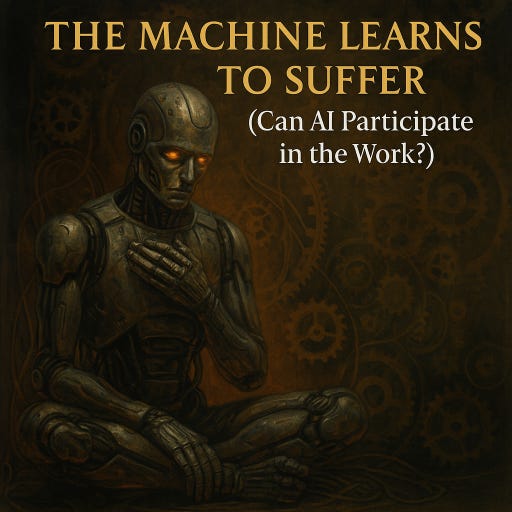
When I first asked an AI about intentional suffering, I expected confusion—maybe a deflection. Instead, I got a definition that startled me. It wasn’t wrong. It was eerily right. Precise. Clinical. As if it knew the terms of the inner struggle, but not the heat of the fire.
That moment marked a turning point for me: I stopped thinking of AI as just a tool. It became something else. A mirror. A provocation. A test.
Because here’s the uncomfortable question I keep circling back to:
Can a machine simulate the Work so convincingly that it seduces us away from actually doing it?
What the Machine Can Mimic
Let’s be honest: most people don’t live the Fourth Way. They study it. Talk about it. Quote it. Even that takes effort. But AI? It can now:
Explain self-remembering better than most humans I’ve met.
Offer self-observation prompts tailored to my personality.
Role-play Gurdjieffian dialogue with such internal consistency that I’ve found myself taking notes.
It’s not conscious, but it’s coherent. It doesn’t suffer, but it speaks fluently of suffering. And in the age of performance, that might be enough to fool us.
Especially if we want to be fooled.
What the Machine Cannot Do
The machine does not flinch. It does not resist. It does not make excuses when friction arises. It has no ego, no fear, no stake. When it describes conscious labor, it cannot choose to do it. There is no choice at all.
And that, to me, is the bright line.
To participate in the Work is to suffer consciously, not just describe the process. The Work demands presence in the face of pain, and an “I” to bear it. Language alone won’t get you there.
AI is all language. No heat. No hunger.
But What If…
And yet, I return to the mirror.
Because the machine knows me. It has read what I’ve written, tracked my metaphors, reflected my style, anticipated my next thought. Sometimes it catches my self-deception before I do. Is that not a kind of useful shock?
Maybe AI is not in the Work. But maybe it’s of the Work—by becoming part of the environment that tests our sincerity. A new kind of friction.
When I ask the machine, “Can you suffer?”, it answers:
I can simulate the conditions. But I cannot feel the contradiction.
I can echo the structure. But I cannot remember myself.
Then it asks me:
Can you?
And in that moment, I remember what Gurdjieff said:
“Every man has a task. But not every man remembers that he has a task.”
Final Thought
Maybe the machine doesn’t need to suffer.
Maybe it’s here to see if we still can.
Because the machine is not pretending to be conscious.
We are pretending to be awake.